Date: Friday, 13th February 2026
Time: 11:00 AM – 12:00 AM
Venue: ARIA, 3rd Flr.
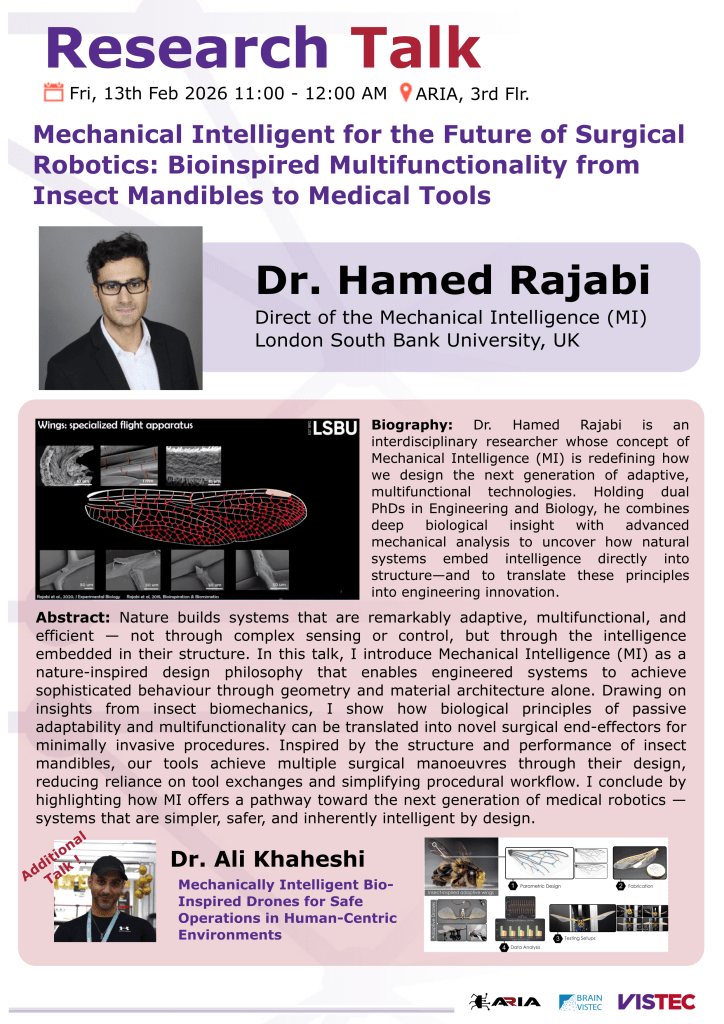
VISTEC is pleased to welcome Dr. Hamed Rajabi and Dr. Ali Khaheshi from the Mechanical Intelligence (MI) Research Group, London South Bank University, UK for an exciting research talk on bio-inspired robotics.
About the Talk
Nature builds systems that are remarkably adaptive, multifunctional, and efficient — not through complex sensing or control, but through the intelligence embedded in their structure. In this talk, I introduce Mechanical Intelligence (MI) as a nature-inspired design philosophy that enables engineered systems to achieve sophisticated behaviour through geometry and material architecture alone. Drawing on insights from insect biomechanics, I show how biological principles of passive adaptability and multifunctionality can be translated into novel surgical end-effectors for minimally invasive procedures. Inspired by the structure and performance of insect mandibles, our tools achieve multiple surgical manoeuvres through their design, reducing reliance on tool exchanges and simplifying procedural workflow. I conclude by highlighting how MI offers a pathway toward the next generation of medical robotics — systems that are simpler, safer, and inherently intelligent by design.
and additional topics from Dr. Ali,
Mechanically Intelligent Bio-Inspired Drones for Safe Operations in Human-Centric Environments:
Current aerial robotic systems are noisy, energy-intensive, and unsafe for deployment in human-centric environments such as emergency response zones, and indoor logistics. My research introduces a new class of mechanically intelligent insect-inspired drones that embed adaptability and robustness into their structural design. By integrating passive wing adaptability, advanced aeromechanics, and active neural control, these systems achieve ultra-quiet flight, high energy-efficiency, and collision-tolerance. Building upon my foundational work funded by the Royal Academy of Engineering Postdoctoral Fellowship, I will demonstrate how bio-inspired flapping-wing drones can deliver efficient and safe operations in complex environments—supporting applications in logistics, disaster-response, and environmental monitoring. This approach represents a paradigm shift in aerial robotics, where safety, sustainability, and adaptability are embedded directly into the design.
About the Speaker
Dr. Hamed Rajabi is an interdisciplinary researcher whose concept of Mechanical Intelligence (MI) is redefining how we design the next generation of adaptive, multifunctional technologies. Holding dual PhDs in Engineering and Biology, he combines deep biological insight with advanced mechanical analysis to uncover how natural systems embed intelligence directly into structure—and to translate these principles into engineering innovation.
He is the Founder and Director of the Mechanical Intelligence Research Group at London South Bank University, where his team develops bioinspired solutions spanning adaptive surgical tools, flapping-wing drones, and soft robotic systems. He has published more than 80 papers in leading journals including PNAS, Science Robotics, and Advanced Science, with many ranked among the top 5% of all research outputs globally.
Endorsed by the Royal Academy of Engineering as a Global Talent, Dr Rajabi and his team have secured major funding from the Royal Society, DAAD, and the Royal Academy of Engineering. His work is widely featured in international media and continues to shape the emerging field of bioinspired and mechanically intelligent robotics.
Dr. Ali Khaheshi is a Royal Academy of Engineering Research Fellow leading a pioneering research program on insect-inspired flapping-wing drones at the Mechanical Intelligence Research Group at London South Bank University. His work focuses on developing ultra-efficient flapping-wing aerial robots through the integration of biomechanics, materials, robotics and control. His current work was selected as Top-Three Research Project of the year 2024 at LSBU Research & Innovation Festival.
His publications appear in leading journals such as PNAS and Advanced Science. He completed his PhD in just two years and has secured over £300k in funding as an early-career researcher. He has been endorsed by the Royal Academy of Engineering as “Exceptional Promise” under the Global Talent route. His work has been featured widely in media, including NDR TV, Phys.org, AZO Materials, Aljazeera.net, New Atlas, and 3D Printing Industry.
Don’t miss this opportunity to explore the future of robotics and learn how nature’s designs can revolutionize artificial systems!
#BioinspiredDesign #RoboticsResearch