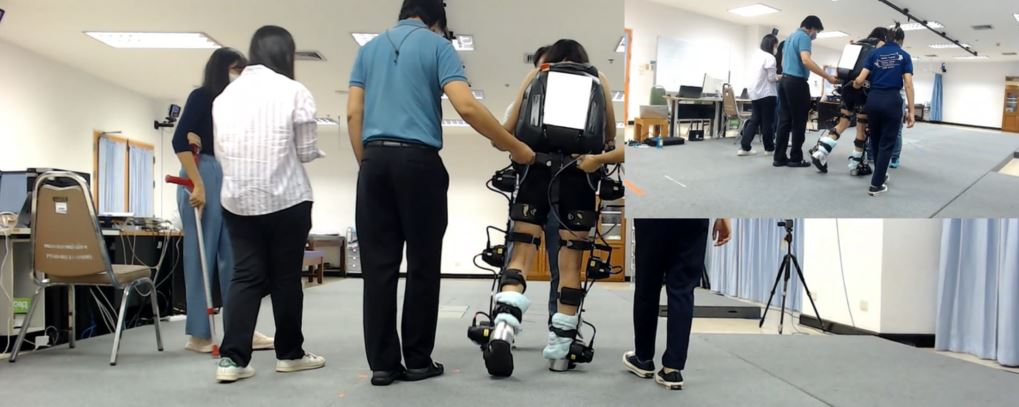


The EXOVIS project funded by VISTEC aims to extend the exoskeleton technology with advanced control for individuals developed by VISTEC and validate it with subjects at Ramathibodi Hospital (RAMA) and the Physical Therapy department (PTMU) (end users). We expect that the outcome of this project will reach TRL6 (i.e., technology demonstrated in relevant environment). This EXOVIS project is an intermediate step to reach TRL9 (i.e., actual system proven in operational environment) or a commercialization stage.
The mobilized lower-limb exoskeleton research platform (Exo-H3) was extended and tested in VISTEC-GAIT at VISTEC. The intelligent control algorithms (e.g., personalized, multimodal, and synchronization algorithms) were developed here and applied to the exo enabling it to learn and assist a subject. A computer station communicated wirelessly (through a local network) with an edge-computing computer attached to the exo via ROS 1 protocol. All control and feedback signals (e.g., joint angle, joint current, joint interaction torque, foot contact) were streamed to a recording computer via MQTT protocol and to a GAIT computer to synchronize the exo with the lab equipment such as a treadmill. During the development period, all computers operated on Ubuntu 20.04.
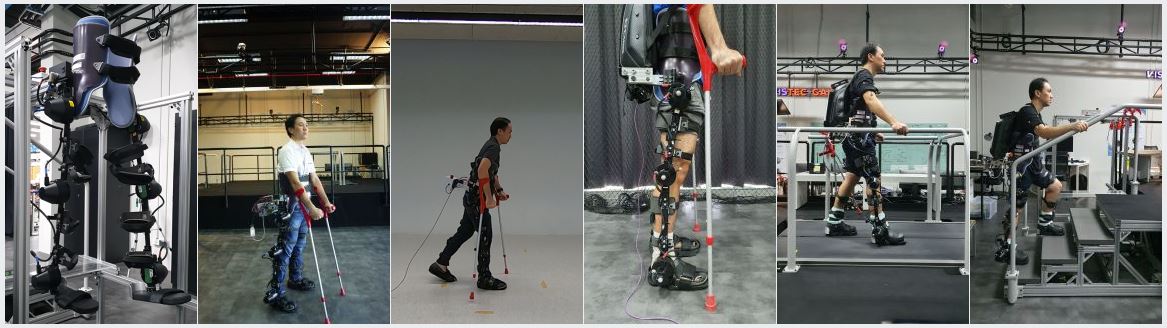
Later, the whole exo platform was validated at hospitals with healthy subjects to acquire comments on both hardware and software aspects.
[2] Srisuchinnawong A, Akkawutvanich C, Manoonpong P. Adaptive Modular Neural Control for Online Gait Synchronization and Adaptation of an Assistive Lower-Limb Exoskeleton. IEEE Trans Neural Netw Learning Syst. 2023;1–10.
[3] Akkawutvanich C, Sricom N, Manoonpong P. Neural Multimodal Control for Versatile Motion Generation and Continuous Transitions of a Lower-Limb Exoskeleton. In: Youssef ESE, Tokhi MO, Silva MF, Rincon LM, editors. Synergetic Cooperation between Robots and Humans. Cham: Springer Nature Switzerland; 2024. p. 311–22. (Lecture Notes in Networks and Systems).
The platform was validated to see how our intelligent control algorithms performed compared to the default control from the factory. The performance metrics measured within the gait lab were muscle activity, metabolic rate, and spatiotemporal information. The functionality and comfortability of using our platform were measured by a questionnaire.
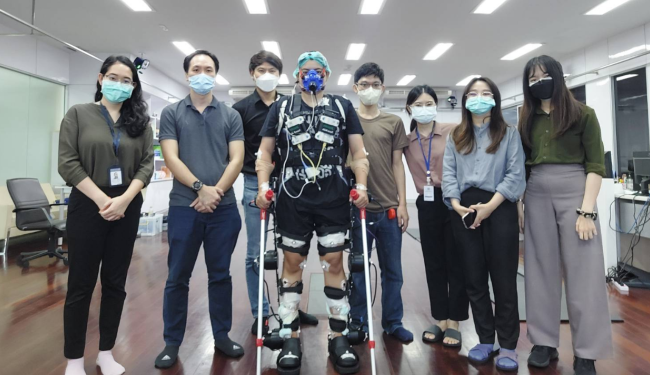
The platform was also validated in the second gait lab at Mahidol University with different subject groups, in this case, a physiotherapist. Mainly, muscle activity, spatiotemporal information, functionality, and comfortability were investigated.